
Jeju Hirasuzuki Fishing Guide: Blackfin Seabass in Korea

|
| Black Proberos soft rubber. Maybe I should buy in bulk, rebrand it and sell it at four times the cost. Maybe I'll call it Sticky Lake Rubber. |
We returned to D'Best Fishing at Pasir Ris Main Pond for a night luring session using soft-plastic rubber lures. This Singapore fishing pond has a long history, and older anglers may still know it as Pasir Ris Main Pond, or PRMP.
This catch report covers our luring approach, tackle, lure colours, retrieval methods and observations from different parts of the pond. We mainly encountered barramundi, although anglers around us also caught snapper, mangrove jack and grouper.
@baktao Went for a short night luring trip at D'Best Pasir Ris Main Fishing Pond. #fishing #sgfishing #luring #singapore
I was 15 years old when I first fished at Pasir Ris Fishing Pond, as it was known then, at Pasir Ris Town Park. I went there with a few secondary school friends, and we caught dozens of large tilapia.
At the time, there was no fishing pond operator, so you could simply fish there for free. A few leftover saltwater fish could also be found in the pond, and I still remember catching a mangrove jack on bread.
After being managed by several fishing pond operators over the years, the venue is now known as D'Best Fishing by D'Best Recreation. Old-timers may remember the larger pond as Pasir Ris Main Pond, or PRMP, and the smaller pond as Pasir Ris Pro Pond, or PRPP.
I have never understood why certain fishing ponds are called “pro ponds”. Maybe “pro” means the pond is more expensive but supposedly has better fishing. They should just call it the “more better pond” lah. Calling it a pro pond makes a shy introvert like me think there will be too many experts there and I will catch nothing.
Ah Du and I decided to visit for some night luring because there were not many late-night pond fishing alternatives left. Farmway 3 and Ed's Pond had closed, while other available ponds felt too small for the type of casting we wanted to do.
During this particular trip, the charge was $56 for a Sunday night session from 9pm to 6am, with a scheduled fish release at approximately 9.30pm. These were the rates during our visit, so contact D'Best Fishing directly for its latest prices, operating hours, fishing rules and fish-release schedule before going.

|
| Picture from the D'Best Fishing Facebook page. |
As usual, I probably overthought the approach because every fishing pond seems to have a code or method to break. Pond fishing is not entirely about luck. Regular anglers pay their “school fees” by spending time learning where the fish gather, when they feed and which presentations work.
For this trip, we were only using artificial lures. I prepared a selection of soft-plastic shads, including White Rabbit and Storm lures, paired with jigheads from approximately 4g to 10g. I also brought older soft plastics such as Trigger X, Proberos, VFOX Vibrotail and Island Anglers rubbers. Sorry, no Z-Man because I ah lau.
One of the first things we wanted to test was lure colour. Many night-luring anglers swear by white soft plastics because they are supposedly more visible in dark water. However, anglers who lure or practise eging regularly may see it differently. Fish might respond more to silhouette and contrast than to colour alone.
White and pink rubber lures worked during the session, but black soft plastics also produced several barramundi. The lesson from our night was simple: do not assume that only bright lures work after dark. Carry both light and dark colours, then let the fish decide.
Combing a fishing pond means systematically working different depths, distances and sections until you locate active fish. It was slightly troublesome at PRMP because we had to move the keep net whenever we changed areas.
We started at the section commonly called “Saudi”, which appeared shallower and had more stagnant-looking water.

|
| First blood at “Saudi” with a White Rabbit pink rubber shad. |
After luring there for a while, we realised that most of the fish appeared to be holding close to the edge. One possible reason was that recently released fish had not yet spread around the pond.
Almost all the fish we encountered there were barramundi, and they responded to a slow, consistent retrieve. Several bites came within a short period, suggesting that the fish might have been loosely schooling. The bait anglers also placed their floats in a straight line roughly 10 feet from the pond edge.

|
| Ah Du caught one by combing the sides. Both of us had a few misses and dropped fish too. |
I was slightly disappointed that the fish were holding near the sides because I wanted to make long casts and hook them farther out. My rod could almost reach the pump, but the fish did not care about my casting ambitions. Oh well.
After leaving the “Saudi” section, we moved to the stairs outside the office. We started late and missed the main fish-release timing, so we had to search for leftover fish that had already dispersed.
Most anglers in this section were also placing their baits relatively close to shore. I managed to catch a “pek tiam” here, while nearby anglers landed snapper, mangrove jack and some grouper.

|
| Pek tiam. Better not say more, later someone called David Ho will find me to drink coffee. |
I continued trying long casts, but they did not produce. We eventually moved to the area after Oceanz Kelong Fishing, where Ah Du dropped a mangrove jack that rushed out to attack his lure as it passed a structure known as the “seal”.
“Maybe this area is where all the grouper are hiding,” Ah Du said.
The area beyond the stairs outside the office had more anglers casting far out. Some were surf casting or fishing PTK style, and there were also more lure anglers in this section. That gave me some hope, so I spent quite a while making long casts. Alas, nothing.
I later chatted with several regulars, who shared the following Pasir Ris Main Pond fishing observations:
These were observations shared during our visit rather than guaranteed rules. Pond conditions, stocking arrangements and fish behaviour can change between sessions.
Some regular lure anglers were seated and repeatedly casting at the same location. Instead of constantly moving, they appeared to be waiting for a short feeding window. Their approach supported the idea that a productive “honey hole” might switch on only when fish move through or begin feeding.
Another interesting observation was that an older regular was also using a black soft-plastic lure, although his lure had a spinner blade attached.

|
| Ah Du nailing one. |
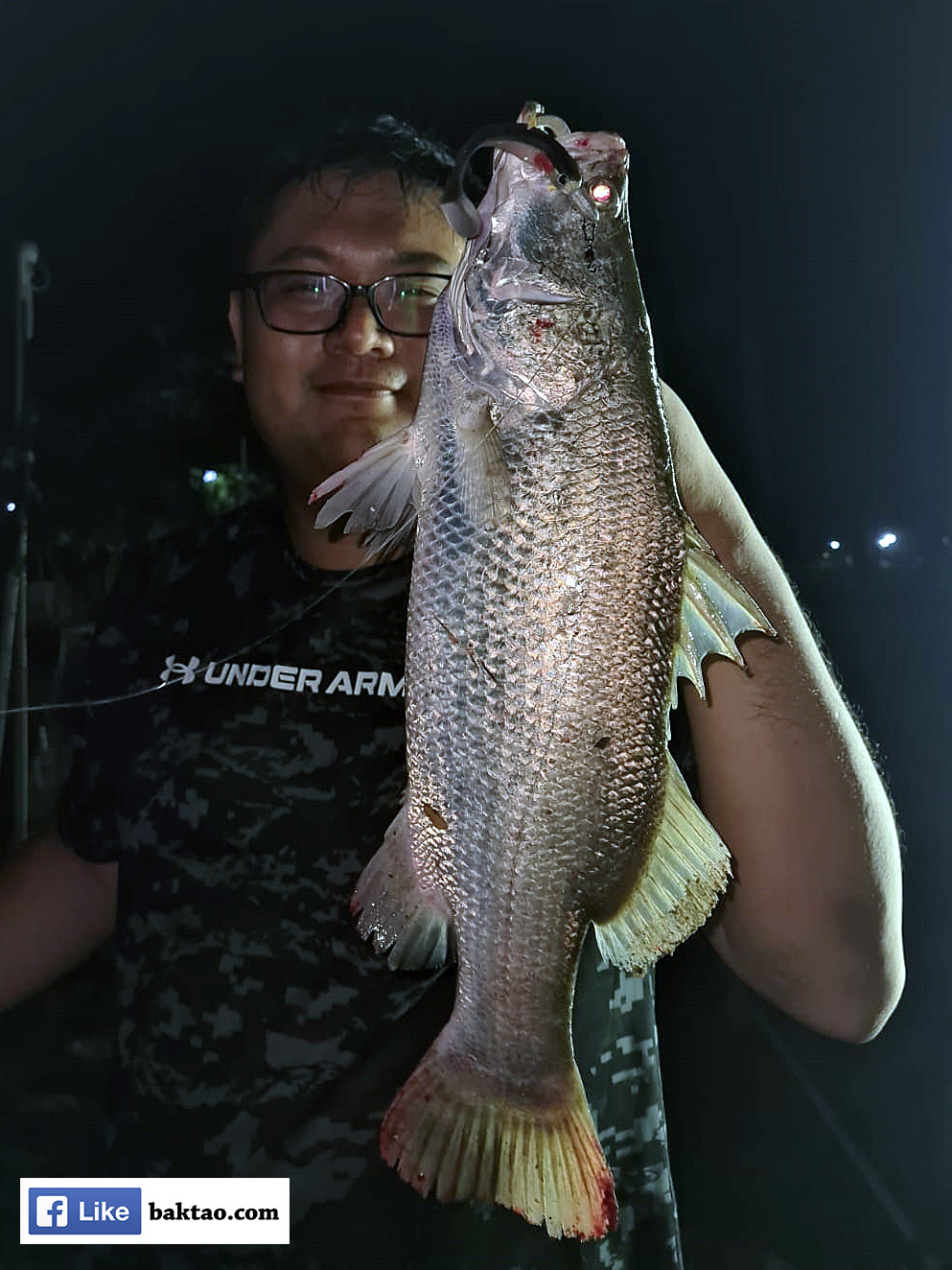
|
| Black Proberos soft rubber. It breaks easily because it is very soft. |
We continued covering the pond and eventually found a section with a school of small mullet or molly-like baitfish. We caught several barramundi there in quick succession, and the fish again appeared to prefer black soft-plastic lures.
I even caught one using a figure-eight retrieve close to the edge. If you see small surface ripples or concentrated baitfish activity, it may be worth working your lure through that area before moving elsewhere.

|
| Absolutely inhaled it. |
After working that area, we headed towards the connecting bridge near Pasir Ris Pro Pond. We did not get any bites there, although several bait anglers already had fish in their keep nets. The supper monster eventually arrived, so we left at around 4am.

|
| Four fish for me and three for Ah Du. Fight inflation ops. |
The fishing was not as fantastic as I remembered it being around 10 years earlier, when catching a dozen fish at PRMP seemed much easier. Nevertheless, the session was entertaining because we tested different lure colours, retrieval methods and theories about where the fish were holding.
Our final result was four fish for me and three for Ah Du. We had a few fish to eat and, as Ah Du said, could “fight inflation”.
Overall, it was an “OK” trip. I do not think my next visit will be anytime soon, though. Hahaha.
D'Best Fishing operates at Pasir Ris Town Park in Singapore. The larger pond is commonly known as Pasir Ris Main Pond or PRMP. Check the operator's latest information before travelling there.
Fish encountered during our visit included barramundi, snapper, mangrove jack and grouper. Stocking and catches vary between sessions, so these species are not guaranteed.
Soft-plastic shads rigged on approximately 4g to 10g jigheads worked for us. White, pink and black lures produced interest, with black rubber lures performing particularly well around visible baitfish.
A slow and consistent retrieve produced several barramundi. Bottom hopping and a figure-eight retrieve near the pond edge are also worth trying.
Not necessarily. During our visit, several fish were holding close to the bank and release areas. Search the pond edge first, then vary your casting distance and depth.


Comments